

Our bones and joints help us walk, run, sit, stand and do our daily work. Good bone and joint health is important for a happy life. But many people have knee pain, back pain, shoulder pain and other joint problems. These problems can make simple daily work hard. Choosing the right doctor is an important step towards better health. Finding the Best Orthopaedic Surgeon in Chennai can help you understand your problem and get the right care.
Why Do You Need an Orthopaedic Surgeon?
An orthopaedic surgeon is a doctor who treats problems related to bones, muscles, joints, and ligaments. These body parts help us move and stay active.
Many people have bone and joint problems because of age, injury, sports, or daily habits. Some people feel pain while walking. Others find it hard to climb stairs or lift their hands.
An orthopaedic doctor checks the problem and suggests the right treatment. Early care can help prevent some problems from becoming worse.
1. Check the Doctor’s Education and Experience
The first step is to check the doctor’s education and experience.
Choose a doctor who has proper medical training in orthopaedic care. Experience is also important when treating bone and joint problems.
A doctor with experience in your health problem may help you understand the treatment choices.
You can check the doctor’s website, education details and work experience before booking an appointment.
2. Know the Doctor’s Treatment Areas
Not all bone and joint problems are the same. Some people have knee pain, while others have shoulder pain or sports injuries.
Choose a doctor who treats the problem you have.
Some common areas of orthopaedic care include:
- Knee pain and knee arthritis.
- Knee replacement surgery.
- Hip joint problems.
- Shoulder pain.
- Sports injuries.
- Bone fractures.
- Ligament injuries.
- Joint replacement surgery.
- Arthroscopy treatment.
Knowing the doctor’s treatment areas can help you make a better choice.
3. Look for Good Patient Care

A good doctor should listen to your health problems with care.
You should feel free to explain your pain and ask questions. The doctor should explain your problem in simple words.
Before choosing a doctor, check whether the doctor:
- Listens to your problems.
- Explains the cause of your pain.
- Answers your questions.
- Explains the treatment plan.
- Gives clear advice about recovery.
Good communication helps patients feel more comfortable during treatment.
4. Check the Hospital and Medical Facilities
The hospital or clinic is also important when choosing an orthopaedic surgeon.
Look for a clean place with the right medical facilities. Good hospitals may have X-ray, scan, operation and recovery facilities.
For surgery, ask about the hospital team and care after the operation.
These details can help you understand where and how your treatment will take place.
5. Understand the Treatment Options
Every patient may need a different type of treatment. Surgery is not needed for every bone or joint problem.
Depending on your condition, the doctor may suggest:
Medicine: Some medicines may help reduce pain and swelling.
Physiotherapy: Simple exercises can help improve movement and muscle strength.
Rest: Rest may help some injuries heal.
Lifestyle changes: Healthy food, regular activity and a healthy body weight can support joint health.
Surgery: Surgery may be needed for some serious bone and joint problems.
Always ask your doctor about the benefits, risks and other choices before starting treatment.
6. Choose a Doctor for Knee Pain
Knee pain is a common problem in many people. It can happen because of age, injury, arthritis or extra pressure on the knee.
Some people feel pain while walking, climbing stairs, sitting or standing.
If knee pain does not go away, visit an orthopaedic doctor. The doctor may check your knee and suggest the right care.
People with serious knee damage may need knee replacement surgery. An experienced knee replacement surgeon can explain whether this surgery is suitable for them.
7. Ask About Robotic-Assisted Joint Replacement
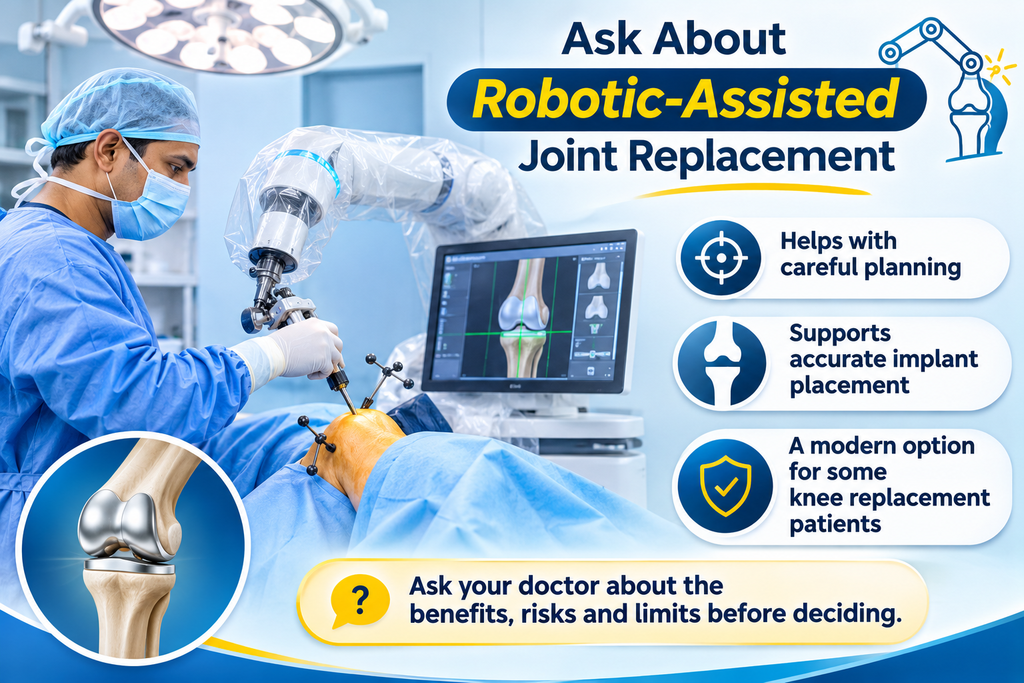
Medical technology is improving every day. Robotic-assisted joint replacement is one option used in some knee replacement procedures.
This technology helps the surgeon plan and carry out parts of the operation with the help of a robotic system.
It can help with careful planning and implant placement. However, it is not the right choice for every patient.
Ask your doctor about the benefits, risks and limits of robotic-assisted surgery before making a decision.
8. Check Patient Reviews and Feedback
Patient reviews can give you an idea about the doctor’s care and communication.
You can read online reviews and feedback before booking an appointment.
Look for comments about:
- Doctor communication.
- Waiting time.
- Hospital care.
- Staff support.
- Treatment experience.
Do not choose a doctor only by looking at online ratings. Your health needs and the doctor’s experience are more important.
9. Ask Questions During Your First Visit
Your first visit is a good time to learn about your health problem.
Do not feel shy about asking questions. Clear answers can help you understand your treatment.
Here are some useful questions:
- What is the cause of my pain?
- Do I need any tests or scans?
- What treatment is right for me?
- Do I need surgery?
- How long will recovery take?
- What can I do at home to protect my joints?
Always follow the doctor’s advice and attend follow-up visits when needed.
10. Choose a Doctor Who Supports Your Recovery
Treatment does not end after a doctor visit or surgery. Recovery is also important.
Some patients may need physiotherapy and regular exercises. Others may need changes in their daily habits.
A good care plan should explain what to do after treatment. It should also tell you when to return for a check-up.
Follow the doctor’s advice and do not start hard exercises without medical guidance.
Meet Dr. Balachandar M – Orthopaedic Surgeon in Chennai
Dr. Balachandar M is an Orthopaedic and Robotic Joint Replacement Surgeon in Chennai.
He has an MBBS and MS (Orthopaedics) qualification, along with FIAA (Netherlands), FASM (Italy), and FIJR (Joint Replacement Surgery).
His areas of care include:
- Robotic-assisted joint replacement.
- Knee replacement surgery.
- Joint pain care.
- Arthroscopy.
- Sports injuries.
- Bone and joint problems.
He is an Associate Consultant at Apollo Hospitals, Greams Road.
To learn more about orthopaedic care, visit Dr. Balachandar M – Orthopaedic Surgeon in Chennai.
Contact Details:
Website: https://drbalachandarm.com/
Phone: +91 9445032227
Address: 18, Kodambakkam Rd, Mettupalayam, West Mambalam, Chennai, Tamil Nadu 600033.
Conclusion
Choosing the right orthopaedic surgeon is an important step for good bone and joint health. Check the doctor’s education, experience, treatment areas and patient care. Ask questions and understand your treatment choices before making a decision.
Do not ignore knee pain, back pain, shoulder pain or other joint problems. Early medical advice can help you find the cause and get the right care.
If you are looking for the Best Orthopaedic Surgeon in Chennai, learn about your doctor’s experience and choose the care that meets your health needs. Take care of your bones and joints today for a more active tomorrow.
Frequently Asked Questions (FAQs)
An orthopaedic surgeon treats problems related to bones, joints, muscles, ligaments and tendons.
Visit a doctor if you have pain, swelling, stiffness or trouble moving your joints. Get medical help for serious injuries without delay.
Check the doctor’s education, experience, treatment areas, hospital facilities and patient care.
Yes. An orthopaedic surgeon can check the cause of knee pain and suggest suitable treatment.
No. Many joint problems can be treated with medicine, rest, physiotherapy and lifestyle changes. Surgery may be needed for some serious problems.
It is a type of knee replacement surgery that uses robotic technology to help the surgeon plan and perform parts of the operation.
Yes. Orthopaedic surgeons with sports injury experience can treat problems such as ligament tears, muscle injuries and joint injuries.
Early medical care can help find the cause of pain and plan suitable treatment. It may also help prevent some problems from getting worse.